
- Your cart is empty Browse Shop
How Technology Is Revolutionizing Agricultural Exports | Global Exporter from India | Worldwide Supplier India
Agricultural exports have undergone a remarkable transformation in recent years, driven by rapid technological advancements. From farm management and quality control to logistics and international trade, technology is reshaping every stage of the agricultural export journey. Exporters today can deliver higher-quality products, improve efficiency, reduce costs, and meet the ever-evolving demands of global markets.
As international competition intensifies, embracing technology has become essential for agricultural exporters seeking sustainable growth and long-term success.
The Digital Transformation of Agriculture
Modern agriculture is no longer limited to traditional farming methods. Digital tools, automation, and data-driven decision-making have significantly improved productivity and product quality. These advancements directly impact export readiness by ensuring consistency, traceability, and compliance with international standards.
Technology bridges the gap between farms, exporters, and global buyers, creating a seamless and transparent supply chain.
Key Technologies Transforming Agricultural Exports
- Precision Farming
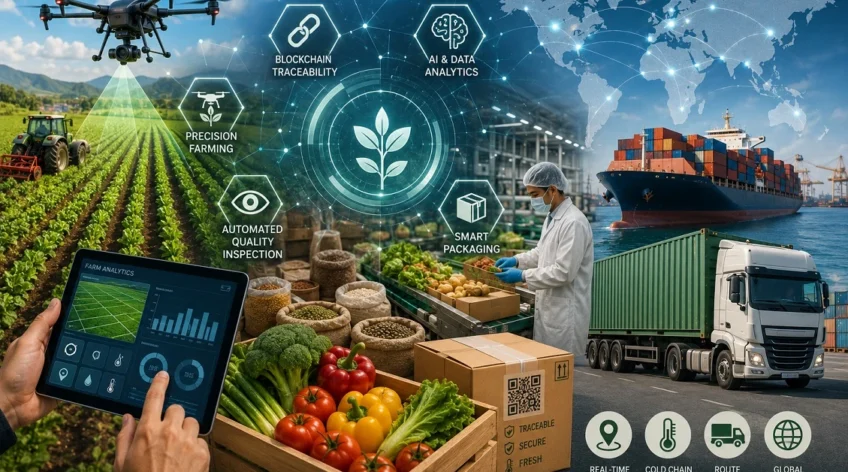
Precision farming utilizes advanced tools such as GPS, sensors, drones, and satellite imaging to monitor crop health, soil conditions, and irrigation needs.
Benefits include:
- Higher crop yields
- Improved resource utilization
- Reduced input costs
- Better quality produce
- Predictable harvest cycles
This allows exporters to secure reliable and consistent supply for international buyers.
- Blockchain for Supply Chain Transparency
Blockchain technology provides end-to-end traceability throughout the export supply chain. Buyers can verify the origin, quality, and movement of agricultural products in real time.
Advantages include:
- Enhanced trust
- Reduced fraud
- Greater transparency
- Improved compliance
- Faster documentation processing
Traceability has become a major requirement in global food trade.
- Artificial Intelligence and Data Analytics
AI-powered systems analyze vast amounts of agricultural data to forecast crop yields, predict market trends, and optimize supply chains.
Applications include:
- Quality assessment
- Inventory management
- Risk mitigation
These insights enable exporters to make smarter business decisions.
- Smart Packaging Solutions
Innovative packaging technologies help maintain freshness and extend shelf life during international transit.
Features include:
- Temperature monitoring
- Moisture control
- Tamper detection
- QR code traceability
- Real-time shipment tracking
Smart packaging reduces spoilage and enhances customer confidence.
- Automated Quality Inspection
Machine vision and automated sorting systems ensure consistent product grading and quality standards.
Benefits include:
- Faster inspection
- Reduced human error
- Uniform quality
- Higher efficiency
- Compliance with export regulations
This is particularly valuable for fruits, vegetables, spices, and grains.
Enhancing Export Logistics Through Technology
Technology has dramatically improved logistics and transportation management.
Real-Time Shipment Tracking
GPS-enabled systems allow exporters and buyers to monitor shipments throughout transit.
Route Optimization
AI-driven logistics platforms identify the fastest and most cost-effective shipping routes.
Cold Chain Monitoring
IoT devices continuously monitor temperature and humidity for perishable goods.
These innovations minimize delays, reduce losses, and improve delivery reliability.
Online presence has become a critical competitive advantage.
Benefits for Agricultural Exporters
- Improved product quality
- Greater operational efficiency
- Enhanced traceability
- Reduced wastage
- Lower logistics costs
- Faster market access
Increased buyer confidence